













Copy link
Copied Link
GESTE DE CONSOLATION
A major project conceived by Alice Diop
OPEN TO PUBLIC. FREE ADMISSION.
OCTOBER 21ST–25TH, 2026
10 AM – 7 PM CEST
LOCATION: PALAIS D’IÉNA - 9 PLACE D’IÉNA, 75016 PARIS
Register now for guided tours
Miu Miu returns as 'Art Basel Paris' Public Program Official Partner for the third year with special project “Geste de Consolation” conceived by Alice Diop.
For its 2026 commission as 'Art Basel Paris' Public Program Official Partner, Miu Miu has invited French filmmaker Alice Diop to conceive Geste de Consolation (Gesture of Consolation), a major project at the Palais d’Iéna headquarters of France’s Economic, Social and Environmental Council - as well as the site of the Miu Miu runway shows. Conceived at the invitation of Miuccia Prada, Geste de Consolation furthers the dialogue begun with “Fragments for Venus”, Diop’s 2025 film for Miu Miu Women’s Tales, further developing its exploration of how Black women have been represented and how those representations remain contemporary stakes. Diop’s very first foray into exhibition-making extends her cinematic vision beyond the screen into narrativized space, bringing together film, photography, sculpture, poetry, dance, music and performance as a montage of encounters and emotions. In doing so, Geste de Consolation continues Miuccia Prada’s lifelong engagement in how cinema and art inspire each other and also opens a new chapter in Miu Miu’s fascination with the lives of women: their experiences, their histories and their hidden stories.
Geste de Consolation focuses on a single question running through Diop’s whole body of work as a filmmaker, unfolding it here as multimedia scenography. “I want my curation to center on acts of consolation conceived by Black women artists, each active in their own discipline, to repair the fetishizing gaze to which centuries of art history have confined us,” Diop says. Geste de Consolation becomes a celebratory chorus of Black creativity united around how looking has been formed by the very representations it confronts, representations that still haunt and shape the present moment.
Diop gathers women who “have healed me, who have nourished me,” into a journey across four interconnected spaces, each organized around a different discipline, voice and architectural atmosphere.
The itinerary begins with a photograph by South African artist Zanele Muholi. Beyond it, Alice Diop’s two-screen video installation features a montage of archival images and film excerpts that have shaped her gaze as a filmmaker through disturbing violent images and those that have consoled her. From this cinematic chamber, visitors enter Chambre à soi (a room of one’s own), a living room and library spread across a patchwork of richly colored carpets featuring a motif by artist Mary Lee Bendolph. A domestic space within the Palais d’Iéna’s monumental concrete structure. This vast library, open to all, makes available the books that have shaped Diop’s intellectual life, but on a wider scale, creates a portrait of a Black woman thinking in the 21st century. Chambre à soi is a space for viewers to dream, create, and build a vision of emancipation. At the center of the exhibition, the welcoming space of the library gives way to a performance arena. Texts by Penda Diouf, Zora Neale Hurston, June Jordan, Audre Lorde, Marie Ndiaye, Zadie Smith, and others are read out live by a rotating cast of performers, including Penda Diouf, Alice Da Luz Gomes, Latifa Laabissi, Séphora Pondi, Davide-Christelle Sanvee, and Betty Tchomanga.
The stage also hosts an adapted version of Ivorian choreographer Nadia Beugré’s Prophétique, performed by six dancers, followed by performances from Chicago composer and musician Angel Bat Dawid with her ensemble, Sistazz of the Nitty-Gritty. The journey ends with a passage onto Simone Leigh’s monumental bronze Sentinel (Mami Wata). Standing nearly five meters tall, its elongated female form is encircled by a serpent. This sculpture is Leigh’s interpretation of a powerful West African water spirit whose image has travelled and transformed across Africa and its diasporas. Possessing both destructive and creative-generative powers, Mami Wata becomes an ambiguous guardian: monumental and silent, watching over the entire space.
Throughout, the exhibition scenography uses the idea of spectatorship itself as an architectural language. Tiered seating throughout the space invites visitors to watch Diop’s images, to watch the performers, to watch one another and finally to confront Leigh’s sentinel. Gazes proliferate, encounter each other. And the contrast between institutional seating and domestic coziness introduces different degrees of comfort and collectivity.
Diop conceives of Geste de Consolation itself as a form of montage, with the guided path moving from one part of the exhibition to another functioning like a film edit moves from one shot to the next. The visitor’s experience accumulates meaning through proximity and sequence rather than direct explanation, leading ultimately to cathartic release. Every placement - sound, word, voice, image - is composed for the body moving through it. Geste de Consolation offers a scenographic journey of remembrance and repair.
Geste de Consolation is part of Art Basel Paris’s Public Program and will be staged at the Palais d’Iéna, Paris. The project is open to the public from October 21st until October 25th, with a preview on October 20th.
Art Basel Paris’ Public Program will feature freely accessible exhibitions, installations, monumental sculptures, and curatorial projects by modern and contemporary artists across storied locations of the French capital.
A major project conceived by Alice Diop
OPEN TO PUBLIC. FREE ADMISSION.
OCTOBER 21ST–25TH, 2026
10 AM – 7 PM CEST
LOCATION: PALAIS D’IÉNA - 9 PLACE D’IÉNA, 75016 PARIS
Register now for guided tours
Miu Miu returns as 'Art Basel Paris' Public Program Official Partner for the third year with special project “Geste de Consolation” conceived by Alice Diop.
For its 2026 commission as 'Art Basel Paris' Public Program Official Partner, Miu Miu has invited French filmmaker Alice Diop to conceive Geste de Consolation (Gesture of Consolation), a major project at the Palais d’Iéna headquarters of France’s Economic, Social and Environmental Council - as well as the site of the Miu Miu runway shows. Conceived at the invitation of Miuccia Prada, Geste de Consolation furthers the dialogue begun with “Fragments for Venus”, Diop’s 2025 film for Miu Miu Women’s Tales, further developing its exploration of how Black women have been represented and how those representations remain contemporary stakes. Diop’s very first foray into exhibition-making extends her cinematic vision beyond the screen into narrativized space, bringing together film, photography, sculpture, poetry, dance, music and performance as a montage of encounters and emotions. In doing so, Geste de Consolation continues Miuccia Prada’s lifelong engagement in how cinema and art inspire each other and also opens a new chapter in Miu Miu’s fascination with the lives of women: their experiences, their histories and their hidden stories.
Geste de Consolation focuses on a single question running through Diop’s whole body of work as a filmmaker, unfolding it here as multimedia scenography. “I want my curation to center on acts of consolation conceived by Black women artists, each active in their own discipline, to repair the fetishizing gaze to which centuries of art history have confined us,” Diop says. Geste de Consolation becomes a celebratory chorus of Black creativity united around how looking has been formed by the very representations it confronts, representations that still haunt and shape the present moment.
Diop gathers women who “have healed me, who have nourished me,” into a journey across four interconnected spaces, each organized around a different discipline, voice and architectural atmosphere.
The itinerary begins with a photograph by South African artist Zanele Muholi. Beyond it, Alice Diop’s two-screen video installation features a montage of archival images and film excerpts that have shaped her gaze as a filmmaker through disturbing violent images and those that have consoled her. From this cinematic chamber, visitors enter Chambre à soi (a room of one’s own), a living room and library spread across a patchwork of richly colored carpets featuring a motif by artist Mary Lee Bendolph. A domestic space within the Palais d’Iéna’s monumental concrete structure. This vast library, open to all, makes available the books that have shaped Diop’s intellectual life, but on a wider scale, creates a portrait of a Black woman thinking in the 21st century. Chambre à soi is a space for viewers to dream, create, and build a vision of emancipation. At the center of the exhibition, the welcoming space of the library gives way to a performance arena. Texts by Penda Diouf, Zora Neale Hurston, June Jordan, Audre Lorde, Marie Ndiaye, Zadie Smith, and others are read out live by a rotating cast of performers, including Penda Diouf, Alice Da Luz Gomes, Latifa Laabissi, Séphora Pondi, Davide-Christelle Sanvee, and Betty Tchomanga.
The stage also hosts an adapted version of Ivorian choreographer Nadia Beugré’s Prophétique, performed by six dancers, followed by performances from Chicago composer and musician Angel Bat Dawid with her ensemble, Sistazz of the Nitty-Gritty. The journey ends with a passage onto Simone Leigh’s monumental bronze Sentinel (Mami Wata). Standing nearly five meters tall, its elongated female form is encircled by a serpent. This sculpture is Leigh’s interpretation of a powerful West African water spirit whose image has travelled and transformed across Africa and its diasporas. Possessing both destructive and creative-generative powers, Mami Wata becomes an ambiguous guardian: monumental and silent, watching over the entire space.
Throughout, the exhibition scenography uses the idea of spectatorship itself as an architectural language. Tiered seating throughout the space invites visitors to watch Diop’s images, to watch the performers, to watch one another and finally to confront Leigh’s sentinel. Gazes proliferate, encounter each other. And the contrast between institutional seating and domestic coziness introduces different degrees of comfort and collectivity.
Diop conceives of Geste de Consolation itself as a form of montage, with the guided path moving from one part of the exhibition to another functioning like a film edit moves from one shot to the next. The visitor’s experience accumulates meaning through proximity and sequence rather than direct explanation, leading ultimately to cathartic release. Every placement - sound, word, voice, image - is composed for the body moving through it. Geste de Consolation offers a scenographic journey of remembrance and repair.
Geste de Consolation is part of Art Basel Paris’s Public Program and will be staged at the Palais d’Iéna, Paris. The project is open to the public from October 21st until October 25th, with a preview on October 20th.
Art Basel Paris’ Public Program will feature freely accessible exhibitions, installations, monumental sculptures, and curatorial projects by modern and contemporary artists across storied locations of the French capital.

ALICE DIOP
Born in 1979, Alice Diop is a French film director and screenwriter. With a deliberately calm but uncompromising visual language, she addresses topics such as identity, migration and colonialism. Her films tell the stories of people whose voices are rarely heard in public. Her work is characterized by her desire to bring unique life stories from the margins to the center. In doing so, she transforms personal stories into political images, marking Diop as a prominent figure in a new, politically engaged French cinema.
She received the award for best documentary film at the 2021 Berlinale, the Silver Lion in Venice in 2022, and was invited to join the Academy of Motion Picture Arts and Sciences in 2024. Her best-known films include Saint Omer (2022), Nous (2021) and Vers la Tendresse (2016). Parallel to her career as a filmmaker, Diop has continued to work in the academic field, driven by her desire for research and animated by a faith in the importance of transmission. She is a member of the faculty at Ateliers Varan and regularly gives workshops and teaches masterclasses at French and American universities, such as Université Paris 8, Paris 1, Columbia, NYU, Yale and Harvard. She previously collaborated with Miu Miu as director of the Miu Miu Women’s Tales #30 short film, “Fragments For Venus” (2025), which premiered as the opening film of the Giornate degli Autori section at the Venice Film Festival 2025 and subsequently screened at the NYFF and the BFI London in October 2025.
Alice Diop is currently working on her next feature, a loose adaptation of one of the monuments of twentieth century literature and anthropology: Michel Leiris’ Phantom Africa.
Born in 1979, Alice Diop is a French film director and screenwriter. With a deliberately calm but uncompromising visual language, she addresses topics such as identity, migration and colonialism. Her films tell the stories of people whose voices are rarely heard in public. Her work is characterized by her desire to bring unique life stories from the margins to the center. In doing so, she transforms personal stories into political images, marking Diop as a prominent figure in a new, politically engaged French cinema.
She received the award for best documentary film at the 2021 Berlinale, the Silver Lion in Venice in 2022, and was invited to join the Academy of Motion Picture Arts and Sciences in 2024. Her best-known films include Saint Omer (2022), Nous (2021) and Vers la Tendresse (2016). Parallel to her career as a filmmaker, Diop has continued to work in the academic field, driven by her desire for research and animated by a faith in the importance of transmission. She is a member of the faculty at Ateliers Varan and regularly gives workshops and teaches masterclasses at French and American universities, such as Université Paris 8, Paris 1, Columbia, NYU, Yale and Harvard. She previously collaborated with Miu Miu as director of the Miu Miu Women’s Tales #30 short film, “Fragments For Venus” (2025), which premiered as the opening film of the Giornate degli Autori section at the Venice Film Festival 2025 and subsequently screened at the NYFF and the BFI London in October 2025.
Alice Diop is currently working on her next feature, a loose adaptation of one of the monuments of twentieth century literature and anthropology: Michel Leiris’ Phantom Africa.
CREDITS
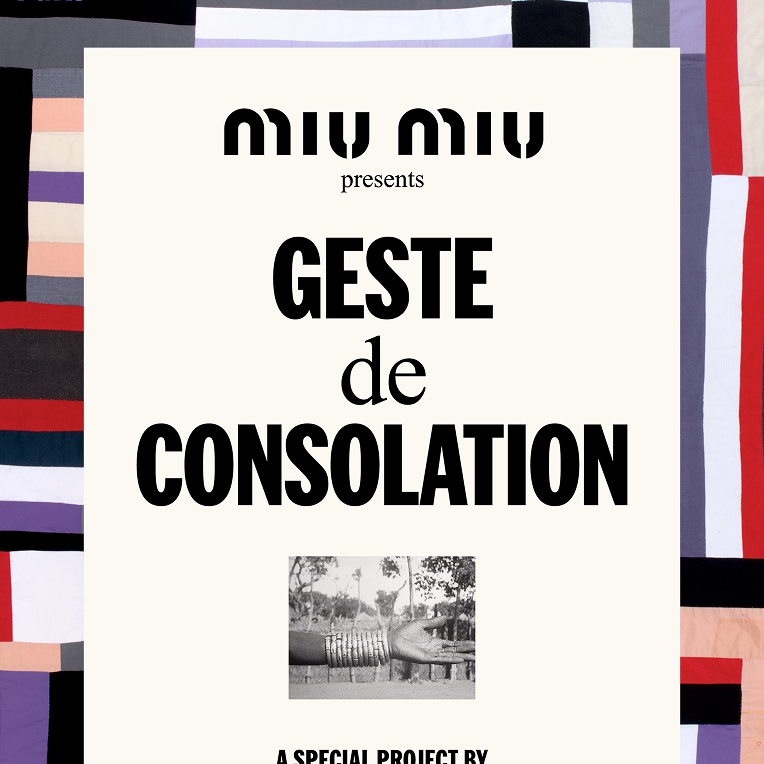
Image courtesy of Nicelle Beauchene Gallery. © Mary Lee Bendolph / Artists Rights Society (ARS), New York.
Image courtesy of Nicelle Beauchene Gallery. © Mary Lee Bendolph / Artists Rights Society (ARS), New York.